I suck at writing.
Yes: that's probably the worst way to kick off a website that relies entirely on my ability to write, but we don't want to start our beautiful story together with a lie, now, do we? It's better to set expectations from the start. Also, if you really think about it, that's actually a good realization to come to. "Oh, really? What's so good about it? lmao", you ask; "because you can only get better at the things you know you're bad at, silly", I reply, not really liking your tone.
It's been over 6 years since I last wrote a blog post, and as I've recently found out, that's a big problem if you want to try getting back into writing again many years later. Case in point: the draft of this very post on Notion is titled V5, and unless you believe I have a penchant for naming drafts after Roman numerals concatenated with their Arabic counterparts, it's clear that this has been taking me some time.
I've tried many different approaches for the other versions, but none of them felt thoroughly satisfying; most of the drafts had paragraphs I was proud of, but in an effort to make them work, I had to glue them together with some incoherent mumbling that was so bad that I decided that I was better off just tossing the entire thing. Even as I write this version, I'm still removing sentences and reorganizing sections: one of the latest changes I made had me audibly utter "yikes", before yeeting 4 lines of text into the void.
This inability to come up with a decent post had been bothering me for a while, largely because I was able to publish stuff just fine 6 years ago without such a seemingly impossible quality standard; moreover, this isn't a post about some advanced topic, like quantum chromodynamics, or how to exit vim *cue sitcom laugh*, so I was really confused as to what could be preventing me from getting this over the finish line.
Fortunately, everything became clear when I learned about this phenomenon described by Ira Glass, dubbed the "taste-skill gap": at all times, there's a distance between your taste and your skill on a specific matter, and the bigger the gap between the two, the harder it is for you to output something that is up to your own standards.
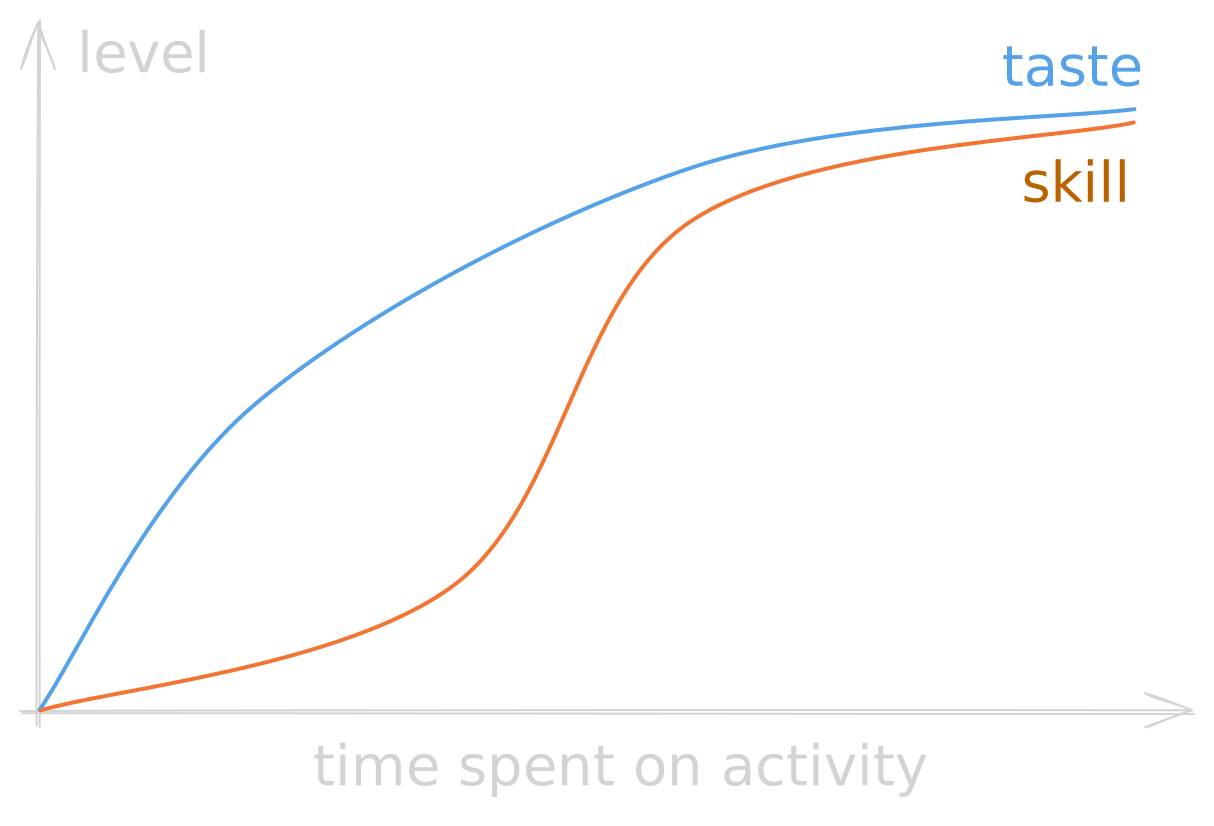
To be completely accurate, it's not "the bigger the gap between the two", because this allows for cases where your taste is inferior to your skill, which I don't think should be possible. A more formal approximation would be .
In my case, even though I had stopped writing, I never stopped reading: blog posts, books, papers — and, of course, tweets, Reddit threads and every variety of non-technical frivolity — all of those have collaborated to change what I perceive as "quality writing", for better or for worse, which meant that, while my taste was being constantly reforged, my skills did nothing but atrophy over the years, making that taste-skill gap increasingly wider.
"Ah, so that’s why you started the post the way you did" well well well, look who’s decided to lose the attitude. You’d be right to think so, but the thing is: that was meant to be the first sentence of the post even before I learned about the existence of the taste-skill gap. A couple of drafts ago, I naïvely thought that mine was a case of the writer's block, so I decided to try to writer's-unblock by asking an LLM to write this post.
Now, before you click away, this is entirely human-written (for better or for worse) and I would never use whatever the model produced, but I thought asking it would still be an interesting exercise anyway: ever since draft V1 (or I1), this post was always meant to be a reflection on what blogs are worth today (given that anyone can write about anything now by asking an LLM to do it for them), so asking AI™ to write it sounded fitting. My thoughts were that a large language model would certainly be able to write this post, but its version would be bland, and generic, and boring, and then I'd come in and say "see, you still need to be a human to write well".
Turns out you don't.
AI text sucks… or does it?
We've seen a massive surge on the amount of AI-generated text on the internet, and the more it proliferated, the more obvious it became for us all that there are some telltale signs that some piece of text was written by an LLM. Some of them show up more rarely in the wild because they're part of the conversational component of LLMs, like "Sure! Here's a list of [something you asked a list of]", or Claude’s infamous "you're absolutely right!".
Some of the patterns, however, are a bit sneakier, and spotting them requires prolonged exposure to AI-generated text. We’ve all collectively accepted that the word "delve", em dashes and excessive amounts of italics and bolds are also AI indicators, as well as what I like to call the epanorthotic antithetical amplification™ (rolls right off the tongue, doesn't it?). In case you're understandably unfamiliar with what that is, it's what I call the "this post isn't just your literary comeback: it's the cornerstone of your next digital empire" kind of structure (or, sometimes found in its shorter form, "this isn't just a blog post — it’s a message").
Over time, for some reason, we've developed a prejudice against this AI prose and its features: maybe because it's a bit exhausting to treat every single thing in the universe as a deep subject that requires so much intensity. It wouldn't surprise me if I talked to an LLM about making my own sweater and it replied with "at this point, you're not just knitting — you're weaving the fabric where your creativity meets your spare time".
Aside from the excessive intensity, said ick could also stem from frustration, and the fact that we encounter AI's rhetorical fingerprints in places we were expecting to find authenticity (like LinkedIn or Twitter); we start reading a post somewhere thinking we're interfacing with another fellow human, and then something in the text gives it away that you're actually interacting with a bot — it feels deceptive. This would also explain why we’re fine to read AI text when it comes straight from the source, but feel weird when we come across it somewhere else.
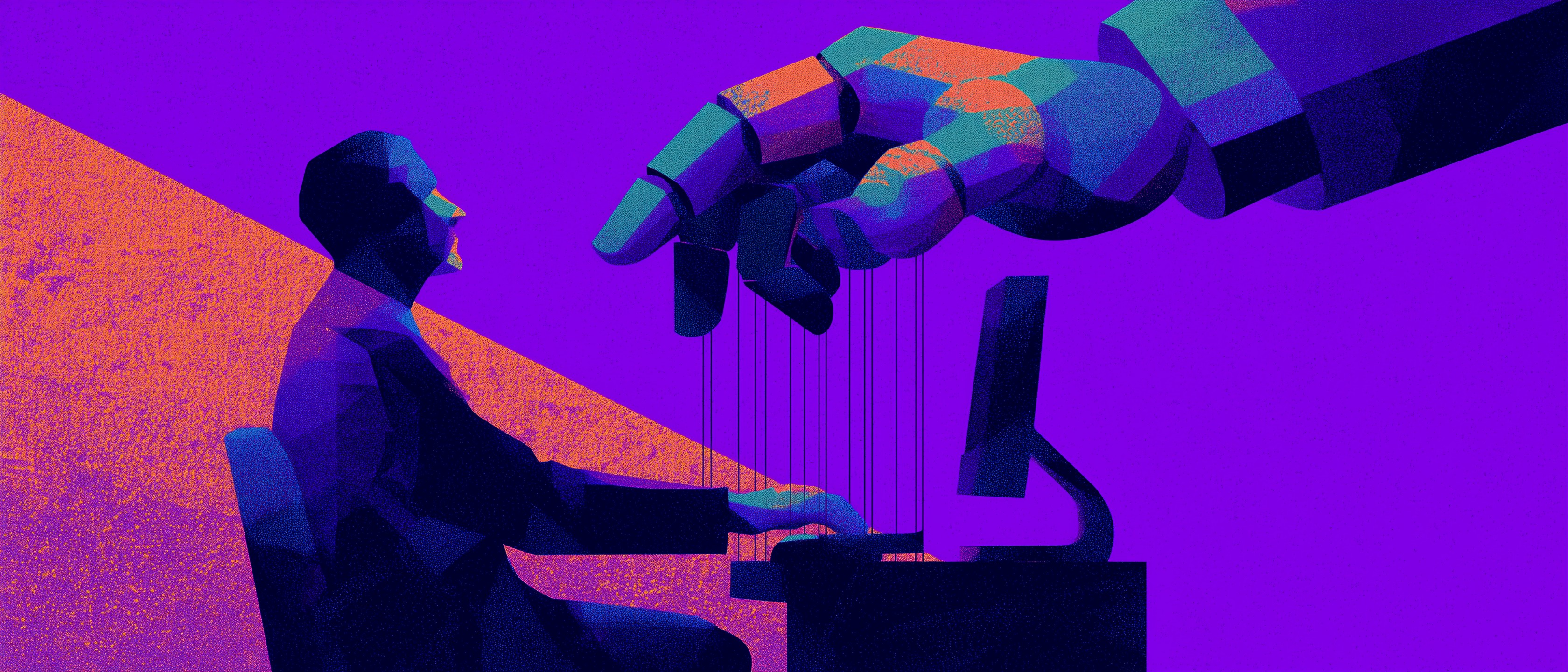
Another possible explanation is the fact that "obviously-AI" text connotes laziness — i.e., whoever generated that text just went with whatever came out of the model they were using, and if they didn't bother to put some effort into it, why should you bother reading it? Notice that this even transfers to formats beyond text: if I had used this image as this post's cover, it would've been very jarring, unlike the stylized artistic version I actually went with, which is very cool and awesome.
These are all educated guesses, however: I don't have the definitive answer that explains this phenomenon (nor is that the point of this article), but we can't deny that we are prejudiced against LLM text. Yes, that prejudice is probably justified, but you need to recognize that it exists and look past it, because otherwise, it prevents you from seeing a harsh truth: that LLM text is actually, objectively, good.
What?
You heard me.
Rhetoric machines
Consider the following sentence: "he didn't just try: he defied fate — and he won". If we lived in a timeline where AI didn't exist, you'd have no problem with this; it sounds good. The anaphora, the poetic beauty of a human dueling against the abstract concept of fate, the short, punchy sentences; it is good writing. We’ve become desensitized to it, and we did learn to associate this sort of text with a general feeling of contempt, but because of what it means — not because it's poorly written, because it's not. It wouldn't have gotten so popular if it were.
A couple of weeks ago, I came across this story by @magnushambleton about a person who picked the green door in the classic "red-door-gives-you-2-billion-dollars-comma-green-door-doubles-your-money-every-day" dilemma. It’s such an engaging, entertaining read, and the craziest part is that Magnus didn’t actually write it; Claude Opus 4.5 did, with the occasional operator fine-tuning. People on Reddit are picking it apart (because of course they are), but when I read the story, I didn’t even think that it was AI — I just thought it was nice; I didn’t notice that the plot didn’t really go anywhere, or that it highlighted something just to let it go moments later — and most people won’t, either, because the overall quality of the text (not the story) is reasonably good.
It's understandable if you disagree, but there's a nonzero chance that you're already biased against AI text; a much more neutral proxy is seeing how people that aren’t chronically online respond to LLM output: even for what I consider the more obvious AI tells, people will still reply to comments that were clearly written by LLMs, and sometimes even praise their output. Since they’re not aware that they’re reading text that was born in the tensor cores of an Nvidia H200, they’re able to evaluate the text for what it is, and their conclusion is that the text not only sounds human (to be worthy of a response), but it also meets their quality standard (to be worthy of a compliment).
There’s also a nonzero probability that you’re laughing out loud right now at the notion that AI text has any quality (and that I’ve written 3 paragraphs defending it), but at least on the rhetorical front, it makes much sense that it does: the entire training process of an LLM is equipped with several tools that will steer the model towards good rhetoric. High quality data is oversampled, content is reweighed to properly rank good and bad text (scientific papers over Reddit threads), and there’s even an explicit step where a human curates the output of the model; all of this makes it so the model is engineered to produce text that sounds good to humans. That’s why it will, sometimes, say the most absurd poppycock as if it were a PhD.
When I asked ChatGPT to write this very post, what it created sounded incredibly good to me, and that's the real reason behind the realization I started us off with. The AI version is effortlessly deep: "the internet doesn’t need more content, but it could use more meaning" is an absolute banger. It was very humbling to realize that:
- I wasn’t able to come up with something that beautiful even after several attempts;
- the LLM had so many rhetoric devices in its repertoire that I didn’t have;
- I'd be even less capable of writing now because I'd have to give up on some of the few devices I do have so I don’t sound like "AI slop".
Looking back at the post ChatGPT produced, I can tell that it’s not that good beyond the text, but I was blown away by it back when I first read it. Had I encountered it in the wild, the text alone would’ve been enough to impress me, to the point I'd think it was human-written, just like the Claude story I mentioned earlier, and here’s where things start to get blurry: what’s human writing worth, if AI writing can, sometimes, pass as human writing?
Of course, it's entirely possible that maybe I just haven’t been exposed to as much AI text as you, so maybe I’m not able to identify all the varieties of LLM-written content — but maybe, you aren't either. Maybe, LLM text and human text are not linearly separable; maybe AI text is just as much of a spectrum as AI videos, ranging from dancing cats to Brad Pitt fighting Tom Cruise. Maybe, you would be able to tell that those stories I fell for were AI-written, but maybe, for a given topic and writing style, you wouldn’t actually be able to discern "rhetoric machine" from man. Maybe, the post you’re reading right now was written by an LLM, but through a carefully curated prompt, with instructions like "make it very average".
All we need to question the value of human writing (and, incidentally, of blogs) is that little bit of maybe.
What’s the point?
Surprisingly, this post is not AI propaganda, nor am I suffering from AI psychosis; in fact, I sit on the far end of the other side of the spectrum. However, LLMs are definitely enough to challenge the value of blogs, since they can write human-sounding text, especially with carefully curated prompts, and it's possible that it can produce text capable of fooling even the most savvy AI connoisseur.
This means just "writing well" (even if you know how to do it [in which case can you teach me?]) isn't good enough — and might, paradoxically, make your posts worse, because you might be running into AI tells, which will summon the AI ick onto your fellow readers. Sure, you know how to avoid the many tells that we know about, but what about the ones we don't? I've been noticing that LLMs really like the word "conflate". Is it common knowledge that this is another "delve"? Or am I wrong and it's just not that common? Or is it a common word for humans and machines alike, so it's alright? If, like me, you don't have English as your first language, that affects you even more, because we can't perfectly classify which words are common and which aren't. Is "hinder" fine? What about "thrive"? Or "fester"? Or "lest"?
To sound human, you have to be a bit more intentional with the words and the literary and rhetoric devices you use, and it can get exhausting to keep track of them. I hope that, over time, we're able to reclaim some of the linguistic features that we've relinquished to AI (like em dashes, which I've been using liberally throughout this post) to make writing easier, but in the meantime, it's probably much likelier that we'll go full circle and get to a point where we start being infected by the LLM-specific idiosyncrasies due to our prolonged exposure to them — in which case we’ll have to put in even more effort to stay on the human side.

So, is it worth it? Is it worth it to spend time and energy carefully choosing your words and figures of speech to, after all that, risk end up being dismissed as AI slop?
I'm a firm believer that the odds that a post is AI-written can never be zero: each one has different probabilities — Cloudflare's .unwrap() outage is much less likely to have been written by AI than a post on AI Prose — but pragmatically speaking, all of them have a nonzero chance, with some of them having a 100% chance, like this Android Headlines post, that had to be scrubbed because of the overwhelming negative reaction to an AI-written post.
Still, I gave this a lot of thought, and I came to the conclusion that there are things that dramatically reduce (at least from my point of view) the likelihood that some piece of text was written by AI. And because I couldn't think of a cliffhanger or a punchy way to end this paragraph, we’re gonna transition in a very boring way to the closing remarks.
Our edge
ChatGPT's version of this post is very efficient: it gets the point across in a very small amount of paragraphs, and it's fine if that's your thing. However, we usually read stuff not because we want to rejoice on the delight that is rhetorical optimization — otherwise entire movies and books could be summarized in a couple of paragraphs too. What we enjoy is precisely all of the discourse inefficiencies, which, among other things, lead us down paths that make us learn new things, meet new characters, empathize and connect.
As you saw, this post doesn't follow a linear path: we took detours — we talked about why we feel weird about seeing AI text out there, what's the inherent quality of LLM content, we talked about figures of speech and literary devices, and all of those are due to proper intent: I knew the answer to the question I posed from the get-go, but to thoroughly answer it while leaving the least amount of loose ends, I had to talk about some adjacent concepts first. If this entire post was "blogs are still meaningful; machines write well, we write different", you might have wanted to challenge the claim that machines write well. You still can, but now I've provided you with substantial evidence of that, which elevates the whole discussion and shows a level of care that is rare to get from an LLM without careful tailoring.
Intent also plays a role on which topics we might want to talk about, and this is what ChatGPT calls "curation" in its version: writing a blog post about the latest Next.js release is something that an LLM can very easily do (and maybe even suggest); writing a blog post about reflections on the optimal way to encode the state of a chess board is a much more specific topic (I'll post that soon enough), and therefore, much less susceptible to be suggested by a language model.
Lastly, the way that you structure the text is also determined by intent: I could have 3 completely separate sections of text introducing different subjects, but that doesn't read well. I prefer to put the post together in a way that sways you through the paragraphs, where the sections are connected and the things I mention further down have been introduced before. Once again, a preference hard to come across in the default settings of the frontier models.
This particular way of presenting text shares some overlap with another important quality that we have that machines don't, which is an identity. We’re able to make jokes, reference things we like, and generally speaking, blend ourselves into the things we write. If you clicked through the links I referenced on the post, you now know that I've watched Brooklyn 99 and The Big Bang Theory, that I'm an avid user of Twitter and Reddit, that I'm not a huge fan of the current state of the AI economics, that I read tech blogs, that I like the occasional self-deprecating joke (hence the name of the blog), and in a couple of paragraphs you'll also learn that I'm into calculus and CinemaSins. Without an identity, text quickly degrade from an enjoyable activity into a chore, where you now have to read paragraphs upon paragraphs of a tasteless, formal monologue — which not only gets boring after a while, but is also much easier for LLMs to generate than something with an actual personality.
Right now, I have a backlog of 115 posts to write. Most of them won't see the light of day, but the way I came across what I consider meaningful topics to talk about is the same way we gather relevant insights to add to other posts: through experience. Of course, curation plays a role here too, but that's the filter: experience is how you gather stuff to put through the filter.
At the beginning of this post, I chose to narrate the odyssey I went through when trying to start (and finish) this post, because one of the 8 people that will end up reading this might be going through the same thing (or might go through the same thing, some day), and the solution for that issue is to just keep practicing. Having that small inefficiency at the beginning, which I can only share because I went through that, transforms this post from a generic analysis into a personal journey that an LLM wouldn't be able to generate by default.
The more
annoyingastute of you might have noticed that my list of human traits is very similar to ChatGPT's: "intent, identity, experience" vs. "personality, taste, experience", and I must agree. However, like Leibniz and Newton (dibs on Newton), we got to the same results independently. Not that I have to convince you of anything; don't think I forgot your attitude at the beginning of the post — you're on thin ice.
All that said, if a piece of text has an identity and visible demonstrations of experience, as well as clear signs of intent, does it unequivocally mean that it's human written? Unfortunately, no. It might just so happen that whoever came up with the post chose to produce it through a very intricate prompt, very meticulously addressing the things I outlined above. This can become very philosophical real fast: at which level of specificity does a prompt-written blog post is essentially human-written? As you replace entropy with determinism by making your prompt increasingly specific, at which point does this AI-version of the ship of Theseus becomes human? That is, quite fortunately (considering the time we've been here already), beyond the scope of this post.
Wrap it up, wrap it up
Do blogs even mean anything anymore (*roll credits*)? Fortunately, they do — and of course we all knew that was going to be the answer; otherwise, I wouldn't have bothered creating this one. Even though they mean slightly less now, because people around the world have the power to write about stuff they don't even know about, you can make your blog mean more by bringing into it the traits that make you, you (intent, identity, experience, in case you forgot).
Was this a whole lot of blabbing? Sure. Could this post have been shorter and still get to the same conclusion? 100%. But that's the thing: the shortest path between two points on Earth is straight through the underground; optimal distance, but you miss out on the views. Then there's a longer path that goes to outer space, around the Sun and back: crazy views, but takes a little bit longer. Hopefully, I was able to strike the balance and take you through the great-circle distance: reasonable time and still enjoyable.
If I didn't, I'll get it right next time. I still suck at writing anyway.